
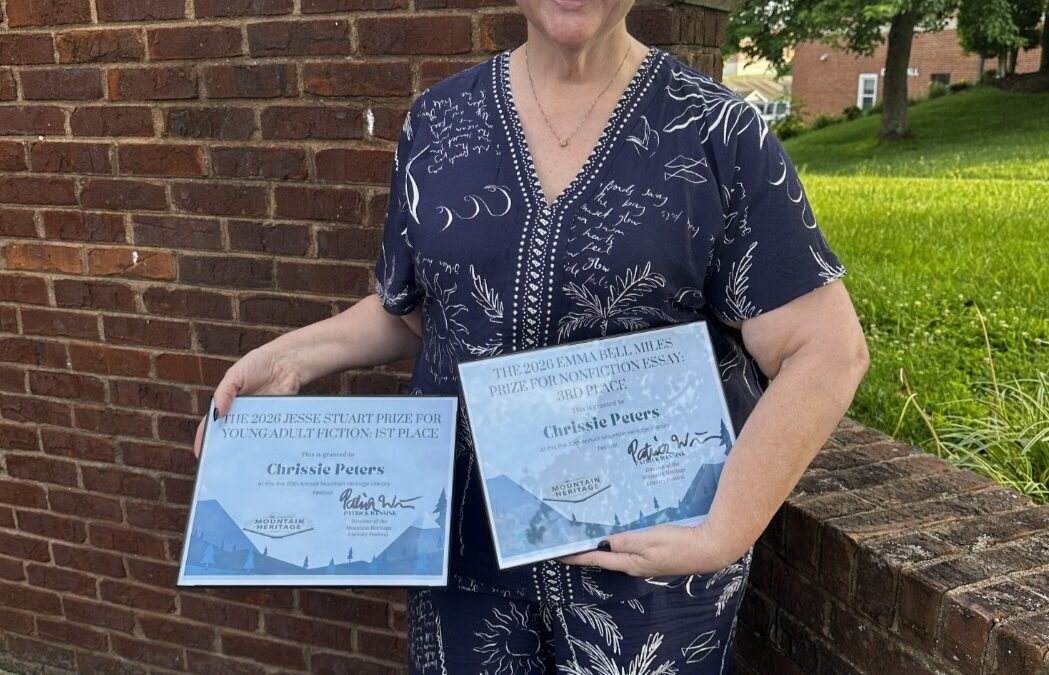
May 29-30, 2026, the 20th Annual Mountain Heritage Lit Fest was held at Lincoln University in Harrogate, TN. Even though it has changed vastly over the years, it is still one of my favorite workshops to attend each year. This marked the last year for Patrick Wensink, as he prepares to take another higher education position. We will miss him and what he brought to the festival in the past few years.
As always, the festival started with the magic of everyone joining together and proclaiming, “I am a writer!” in the theater at the Lincoln Library. This has always been one of my favorite moments at a festival. It puts all of us on equal footing. It makes us all believers. It turns us into doers, not just thinkers. It’s a call to action and an affirmation. It is to this festival what “The Briar’s Sermon” is to the Appalachian Writers’ Workshop.
I went to outstanding sessions all weekend, starting with Charles Dodd Whites’ “Learning Fiction Writing by Listening to the Radio.” I started another Langston story, one that wouldn’t ever be used in my collection, but one that might be worth pursuing as a short story just because I enjoy writing about the main character of the story.
The next session I went to was “The Writer’s Toolkit: Attention, Rhythm, & Transformation,” with Mandi Fugate Sheffel. Among the notes I made for the session was the observation, “Darnell is so present in this room; Sarah K., Larry, Natalie, Sue Ella, me…” I wrote abut who I sat with at dinner (Kelsey) and why (because I knew she would have great stories to share). And that all of our table mates made the dinner so meaningful — those other folks included the guy who’s over the Mildred Haun Conference, whose name I always forget, Larry Thankcer, and Natalie Kimbell. We just had the best time discussing all sorts of eclectic things, and that laughter was so needed in my life. Mandi also talked about how to take care of what is asking for your attention as a writer, using Silas House’s “Stovetop Analogy,” which boils down to, you don’t cook one thing at a time, but sometimes, you have to move things around on the burners to tend to what is most important at the time. So, what is asking for your attention as a writer? Figure that out and take care of it, but keep your other stove eyes going, too. For Transformation, she asked us to take something and change the voice of it. I’m not sure I did it right, but I took part of the epilogue of my short story collection and told it from the point of view of one of the other characters. It was interesting to see her take on things.
The next morning, I started out with Charles Dodd White again. I can’t find the schedule of events, so I can’t tell you the name of the class, but he talked some about “Creative Afterlives.” As examples, he mentioned Maurice Manning’s poetry collection Bucolics, which is now a sound project, and Beth Macy’s Dopesick novel, which became a Hulu special series. He posed the question, “If someone made something from your work, what would you want it to be? What would you be willing to let them change or not?” Which reminded me a lot of hearing David Baldacci speak at VLA so many years ago and talk about seeing his book turned into a movie starring Clint Eastwood, sitting there the first few minutes, excitedly saying over and over, “Oh, my god, this is my book! This is my book! This is my book!” And then, like five minutes in, shaking his head and saying, “Whoa! That’s not my book!” But realizing that was the price he paid in exchange for being paid to let them make the movie from the book that had been his.
Next, we went back to Mandi for “Through Appalachian Foodways.” I had been through this class at the Mildred Haun Conference and enjoyed it, but it was a different experience with different people. I started writing a piece about learning to make sausage gravy after college. She gave us several structures/forms for food-centered nonfiction: The Gathering Story, The Object Essay, The Foraging Walk, The Kitchen Table, and The Recipe Essay.
After lunch, I attended Rewilding: Field Notes in Nature Poetry with Meg Wade. I tried to write about Denton’s foxes, but I hadn’t had the “write” experience with them yet. It was an interesting class, even though I’m really not a nature person. (I really ought to know/learn more about nature. Foxes are beautiful, and I’m sure so much other stuff is, too.)
Wes Blake did a phenomenal class on Flash Fiction. He went into the various classifications of “flash” and how many words each one has: microfiction (300 or less), drabble (100 or less), the six-sentence story, hint-fiction (25 words or less), three-minute stories (on NPR), and the 6-word memoir. He also challenged us to do a five-minute sprint for an anecdote. Then to do a second one. Then the challenge was to find a way to tie those two anecdotes together in one structure. Then he gave us time to write a six-sentence story. I wrote one about my father having cancer.
The next class I have notes from was also taught by Wes. It was on Publishing. I’ll be honest. There was so much excellent information in this session, my notetaking could not possibly do it justice! Wes is one of the most talented, engaging, and giving instructors I’ve come across in quite some time. If you’re not familiar with him, get there! (www.WesBlake.com) Notes I have include — JaneFriedman.com/query-letter
“Revising a story is like cleaning a fish: cut the head off first.” — Chris Chambers
“How I Write” Podcast (McMillan CEO
Places to consider subscribing to in order to find out about prizes and publications:
Publishers Marketplace ($25/month)
Query Tracker ($25/Year)
Chill Subs Comps Books
New Pages (great for contests)
Poets & Writers Contest Guide
Then we had the awarding of prizes and Keynote Speaker in the Chapel.
I was thrilled to bring home first place in Young Adult for “Circles” and third place in nonfiction for “A View to a Kill,” from my memoir.
Silas House was our Keynote Speaker. He talked about started the Festival twenty years ago with Denton Loving. There were a few people there who were present at the very first festival. He asked if I was there. I wasn’t. I didn’t tell him, but I hadn’t yet found my voice in 2006. It would be another three years or so before I got there, before I started writing my stories and embracing who I was. But the MHLF and Hindman were paramount in that discovery and celebration of being able to just be me when I wrote, no pretense, no grand fiction like I’d always been taught. I could write about people like me, and it was more than okay — it was acceptable. That all seems like a lifetime ago. And in a lot of ways, I guess it was. But I thank God for that lifetime. Silas also read from his latest book, a book of poetry, and signed books outside the chapel. It was a nice evening. It’s always hard to leave. Like any other great writing event, you know that the fairy dust will fade after you drive home, and you ache to take some of that with you on the road.
I’m appreciative to everyone who made it such a great event. I’m thankful for old friends and new friends alike. And, as always, I’m thankful to Denton for letting me stay at The Orchard Keeper the week leading into the festival so I can get work done leading into the festivities. Especially this year. I finished up the edits for my short story collection and got them sent in on Sunday night, after I got home. Until next year…
Recent Comments